Catalysis and Separations Core
About the core
The CSC is a a new multi-user core facility located in the Chemistry Department at Yale University. Our instruments and laboratory space are in Room 307 of the Class of 1954 Chemistry Research Building. We aim to enable data-centric research in the areas of catalysis and separations. Specifically, we house equipment for high throughput experimentation and analysis, separations of difficult mixtures (both chiral and achiral), and in operando monitoring of chemical reactions. We ask that any prospective users contact the director of the CSC to discuss the capabilities of the center. Requests for instrument training are handled via PPMS.
The core offers a wide variety of scientific instruments to support research in synthetic chemistry, including UHPLC, PrepHPLC, SFC-MS (UPC-MS), EasyMax for parallel reactions, solid and liquid chemical dispensing robots, and other equipment for high-throughput experiments (HTE). Our staff maintains the instruments and provides training in their operation for both new and experienced users.
We provide assistance to researchers in two primary areas: catalysis and separations.
Catalytic reactions are increasingly important in a wide array of chemical transformations. From polymers to sustainable fuels to organic transformations, studying catalysis is both vital and complex. The CSC provides tools to researchers to study reactions, both using operando and offline analysis methods. Our tools include manual and automated dispensing tools to enable high throughput experimentation, equipment to study reactions at high pressures, and analytical equipment.
Just as important to understanding chemical reactions is separations. With state-of-the-art chromatography tools, we enable researchers to quickly analyze reaction performance through chiral and achiral separations. Two dimensional chromatographic techniques enable researchers to analyze their reactions even when mixtures are complex. Using all of these tools, the CSC can assist researchers in tackling important and complex research questions.
Available to Yale researchers only
Instruments/equipment
-

Jasco Semi-Prep SFC-MS System
Designed for rapid isolation of complex mixtures as a two-dimensional SFC-MS system, equipped with both chiral and achiral columns.
Available to Yale researchers only -
Waters UPLC/SFC 1- and 2D system
Designed for rapid analysis of complex mixtures, the system can be used as either a stand-alone SFC-MS or as a two dimensional system.
Available to Yale researchers only -
Analytical to prep HPLC
For isolation-scale reverse phase separations. Fitted with both analytical and prep-scale columns to assist transfer of analytical methods. Fitted with a diode array detector.
Available to Yale researchers only -
EasyMax & ReactIR
Offering automated control and recording of temperature, pressure, stirring rates, in situ IR, and almost any external sensor, the EasyMax is great for data-rich experiments.
Available to Yale researchers only -
Parr 5000 parallel pressure reactor
Designed for high-pressure reaction screening. Equipped with six 45 ml reactors made of alloy C276 with individual stirring, heating, and pressure transducers.
Available to Yale researchers only -
Trace 1300 GC-FID-TCD
For analysis of simple to complex reaction mixtures. The two columns enable the GC to analyze both organic products and permanent gases. Other columns available as needed.
Available to Yale researchers only -
-
Chemspeed Crystal Powderdose
Built for general-purpose solid dispensing of up to 7 solids in to 3 plates, this instrument is great for queueing tedious solid dispensing tasks.
Available to Yale researchers only -
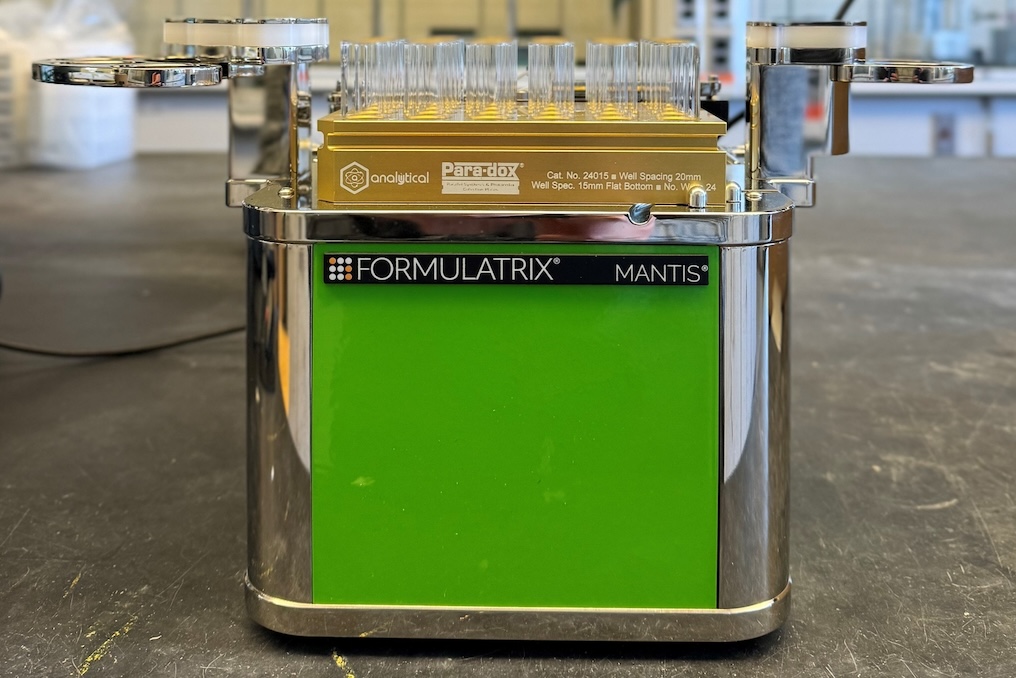
Formulatrix Mantis
Available for dispensing as little as 0.1 μl with as little as 6 μl dead volume, this liquid dispenser is great for adding reagents to 24-, 48-, 96-, and 384-well plates.
Available to Yale researchers only -
High-throughput mixing and stirring
If you need to mix or stir blocks of many reactions, we have several solutions available for running reactions from -10 to 180 °C.
Available to Yale researchers only -
Plate pressure reactor
From V&P Scientific, this reactor allows for screening up to 48 reactions in GC vials at pressures up to 300 PSIG. Reactions have a shared headspace.
Available to Yale researchers only -
Savant SpeedVac
This centrifugal evaporator is designed for parallel evaporation of vials and plates. The incorporated condensing trap eliminates the need for cold baths.
Available to Yale researchers only -
High-pressure NMR tubes
These NMR tubes are made from PEEK polymer and capable of withstanding pressures up to 500 PSI. Used for work in with spectrometers in the CBIC.
Available to Yale researchers only -
Eppendorf pipettes
We have a variety of Eppendorf micropipettes. Manual and electronic single- and multi-channel pipettes allow for rapid dispensing of simple plate designs.
Available to Yale researchers only




Resources
Want to learn about state-of-the-art reaction optimization and separations? Click here to find resources that provide a great starting place for how to optimize your reactions and separations. Whether you want to learn more about column selection, substrate selection, designing screens, Design of Experiments (DoE), or why you might want to run reaction screens in the first place, these resources are a good starting point. Check back, as I will try to keep this page updated as I find more resources.
Rates
The maintenance and operation of these instruments is made possible by usage fees. We strive to keep these fees as low as possible.
Contacts
Catalysis and Separations Core
The Class of 1954 Chemistry Research Building (CRB), rm 307
Yale University
275 Prospect St., New Haven, CT 06511

-
Core/facility
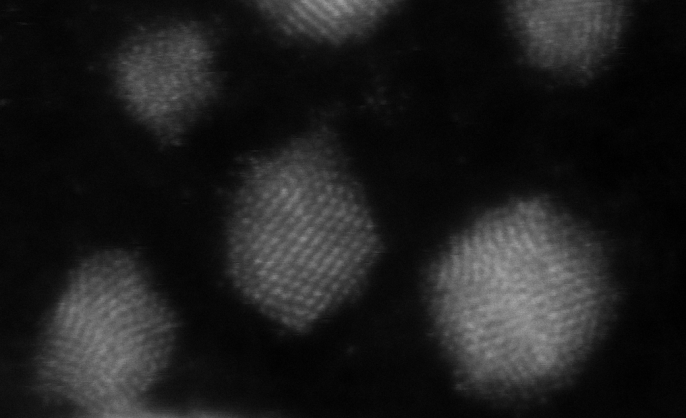
Aberration-Corrected Electron Microscopy (ACEM) Core
Our core's focus is cutting-edge and high-throughput capability in electron microscopy techniques, including TEM, SEM, and FIB.
-
Core/facility

Advanced Instrumentation Development Center (AIDC)
Our mission stands at the nexus between hardware, computing, and data science.
-
Core/facility
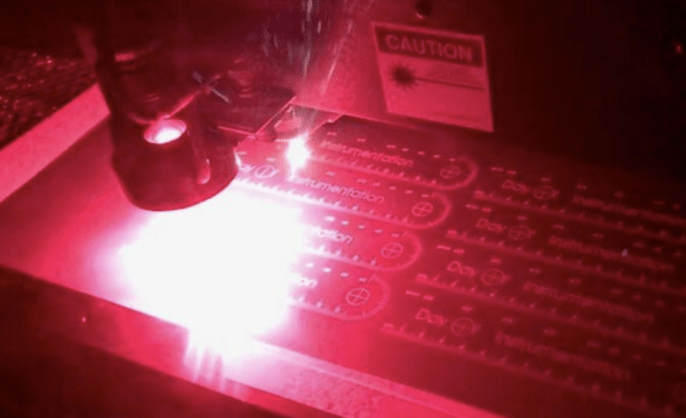
Advanced Prototyping Center at Wright Lab
The Advanced Prototyping Center is a fabrication and design support facility to help Yale researchers with custom instrumentation.