Laser cutting
The laser cutter is a computer‑controlled cutting and engraving system optimized for flat materials. Like the abrasive water jet, it is best suited for sheet stock, but it also supports high‑resolution surface etching and marking. While similar in overall concept, this laser cutter is geared to thinner and nonmetal materials than the waterjet, such as acrylic.
Coherent Meta 2C
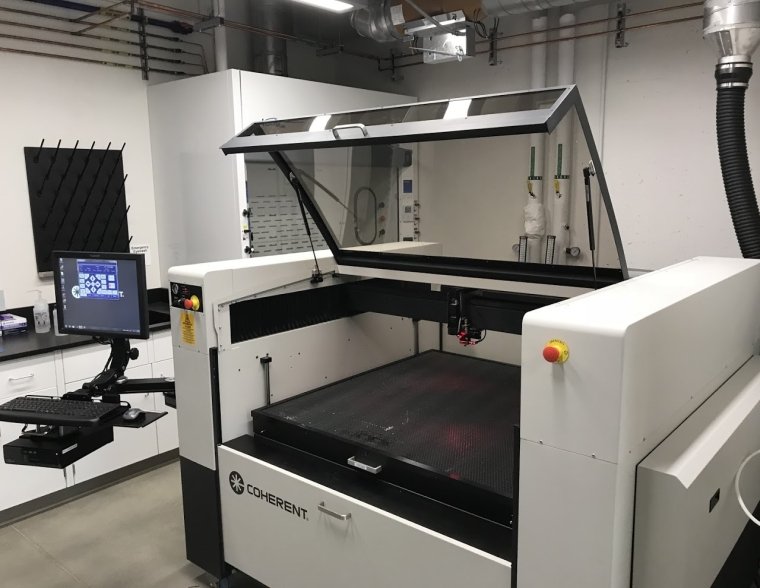
The Coherent Meta 2C is a 250 W CO₂ laser system operating at a wavelength of 10.6 μm. It is particularly well suited for nonmetal materials.
System specifications
- Laser power: 250 W
- Wavelength: 10.6 μm
- Cutting bed size: 1.2 m × 1.2 m (4 ft × 4 ft)
Capabilities
The large cutting area makes this system ideal for full‑sheet layouts and larger projects.
| Acceptable materials | Unacceptable materials |
|---|---|
|
|
Acrylic considerations
Acrylic is one of the most commonly used materials on the laser cutter, but material selection is important. Cast acrylic is strongly preferred over extruded acrylic, as it cuts more cleanly and produces better edge quality. Some specialty acrylics contain additives that may interfere with cutting or engraving and should be evaluated with care.
Acrylic sheets are typically supplied with protective coverings on both sides. If the covering is plastic film, it must be removed prior to cutting and some surface marking may occur. If the covering is paper, it may be left in place and often results in a superior surface finish.
Etching and marking
In addition to cutting, the laser cutter can be used for high‑quality engraving and etching. It is particularly effective at removing dark anodization from aluminum panels. This capability is well suited for producing labels, legends, and indicators on enclosures and control panels.
Design requirements
Material sizing and layout can be nontrivial, particularly for thicker or nonstandard materials. Users are encouraged to consult staff if there is any uncertainty.
The laser system uses interchangeable lenses with focal lengths of approximately 60 mm or 120 mm, depending on the application. The resulting kerf width varies based on material thickness and composition and should be considered during design.